
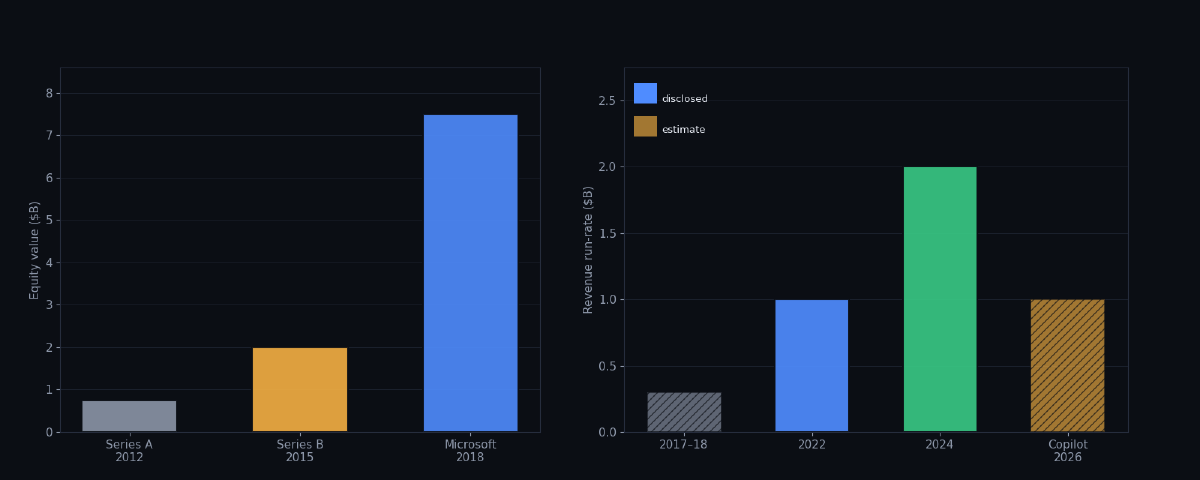
GitHub is one of the most economically interesting private companies an investor cannot buy. Since October 25, 2018 it has been a Microsoft subsidiary — its results folded into the Intelligent Cloud segment without a line item of their own. Yet its monetization just went through a structural shift (usage-based AI billing in June 2026, Copilot bundled into GitHub Enterprise in October 2026), which means the value embedded in Microsoft’s stock is changing too. Building the picture takes three layers: confirmed disclosures, press-sourced estimates, and plain arithmetic — each labeled as what it is.
The equity record: $750M → $2B → $7.5B #
GitHub’s funding history is short and extreme. The company was bootstrapped — profitable nearly its entire pre-VC life, growing revenue at close to 300% annually when Andreessen Horowitz wrote its largest-ever check in July 2012, per a16z’s own announcement (2012-07-09). Valued at ~$750M (AllThingsD, 2012-07-09), it took three more years and one more round to reach exit.
| Date | Event | Value | Source |
|---|---|---|---|
| Jul 2012 | Series A — $100M (a16z only) | ~$750M | AllThingsD; a16z |
| Jul 2015 | Series B — $250M (Sequoia, a16z, Thrive, IVP) | ~$2.0B | Forbes; Bloomberg |
| Oct 2018 | Microsoft acquisition | $7.5B | Microsoft; SEC 10-Q |
Microsoft announced $7.5B in stock on 2018-06-04; the deal closed 2018-10-25. A detail worth knowing: the $7.5B was inclusive of $1.3B in cash payments for vested equity awards and an indemnity escrow (Microsoft 10-Q, Note 7). Purchase accounting booked $5.44B of goodwill plus $1.30B of intangibles — customer relationships $679M/8yr, technology $447M/5yr, marketing $170M/10yr — and reported GitHub inside Intelligent Cloud.
The price was roughly 25–30x revenue: contemporaneous reporting put ARR at ~$300M (CNBC, 2018-06-05), and HBR called it “close to 30x ARR — an astronomical multiple,” comparing Microsoft’s 7.2x revenue purchase of LinkedIn. In three years the Series B price stepped up 3.75x. Bloomberg named a16z (and Sequoia, which had turned $250M of Series B) the biggest winners of the sale.
One more governance fact investors should track: in August 2025, CEO Thomas Dohmke departed and GitHub was folded into Microsoft’s CoreAI organization (The Register, 2025-08-11) — the “operate independently” promise of 2018 quietly ended.
How GitHub makes money in 2026 #
The revenue stack has four layers:
- Platform seats. Repo hosting and collaboration for enterprises — the original business, sold as per-user licenses.
- Copilot subscriptions. Individual plans at $10/mo (Pro), $39 (Pro+), and a new $100 Max tier; organizational seats at $19 (Business) and $39 (Enterprise) per user per month (GitHub pricing pages, 2026).
- Metered AI usage. Since June 1, 2026, every Copilot plan runs on GitHub AI Credits — token consumption priced at ~$0.01 per credit, billed beyond included allowances (GitHub blog, 2026-04-27). Code completions stay unlimited; expensive agentic work is metered.
- Bundling. As of October 28, 2026, Copilot is included with GitHub Enterprise Cloud — enterprise budgets, not seat counts, become the revenue lever (GitHub changelog, 2026-10-28). GitHub Actions minutes (also consumed by Copilot code review) and other services ride on the same stack.
The customer counts that matter, all from Microsoft’s earnings calls: paid Copilot subscribers grew 1.3M (Jan 2024) → 4.7M (Jan 2026, up ~75% YoY); ~140,000 organizations use Copilot (Apr 2026); total Copilot users reached 50M (Jul 2026); and Copilot revenue grew more than 60% quarter-on-quarter after the usage-based switch (FY26 Q4 call, Jul 2026).
Confirmed numbers, honest estimates #
The revenue milestones that can be pinned to a person and a date:
| Date | Figure | Source |
|---|---|---|
| Aug 2017 | ~$200M run rate | GitHub statement |
| Jun 2018 | ~$300M ARR around the deal | CNBC sourcing |
| Oct 25, 2022 | $1B ARR, 90M users | Nadella, FY23 Q1 call |
| Oct 2024 | $2B run rate; Copilot >40% of GitHub’s growth | Nadella, FY25 Q1 call |
Everything else is an estimate — cross-check them yourself. Copilot at 4.7M mostly-Business seats implies 4.7M × $19 × 12 ≈ $1.07B/year before mix effects (many seats are $10 Pro, and enterprise-bundled seats carry no separate Copilot charge). That brackets analyst estimates: Axis Intelligence Research put Copilot at $0.9–1.1B ARR in early 2026; the FT’s floor from the cheapest tier alone is $550M. The widely repeated “$2B Copilot ARR” of 2025 was never a Microsoft disclosure — a useful caution about repeating private-company numbers.
What the numbers imply for value #
Illustrative only, but disciplined: at the last confirmed disclosure — $2B run rate, Oct 2024 — applying 8–15x (where mature, profitable SaaS trades) gives $16–30B. The 2018 buyer paid 25–30x on far slower growth; Copilot’s estimated ~$1B ARR at AI-code-premium multiples would add on top. Against that, the market GitHub competes in had surpassed $3.1B in run-rate revenue across all vendors by late 2025 (The Information, 2025-11-25), with the top three holding ~70% share and GitHub’s AI-code offering estimated around $800M ARR (CB Insights, 2025-09-02) — a leader position being contested by IDE-native challengers.
The real “equity evaluation” today is therefore an internal one: whatever GitHub is worth sits inside Microsoft’s market value. For a public investor, exposure = Microsoft stock (or an index that holds it), and the GitHub story is a quarterly checklist: updated run rate (last: $2B, Oct 2024), paid subscriber growth, organization counts, and whether usage-based billing revenue keeps the +60% cadence — plus any disclosure of the AI-code competitive picture.
The honest caveats #
- Run-rate/ARR figures are not GAAP revenue; Microsoft reports nothing GitHub-specific in its income statement.
- Every Copilot ARR figure outside a Microsoft earnings call is an estimate, and estimates disagree by hundreds of millions.
- The June 2026 billing shift changes revenue quality (metered vs seats) before it can change any multiple ascribed to the business.